Alberta Billing Rejection Codes Explained
— Fix Every Denial (2026)
The average Alberta GP loses $800–$1,200/month to rejected claims that sit unfixed in an EMR queue. Most of them could be corrected in under five minutes — if you know what each code means and exactly what to do. This is that guide.
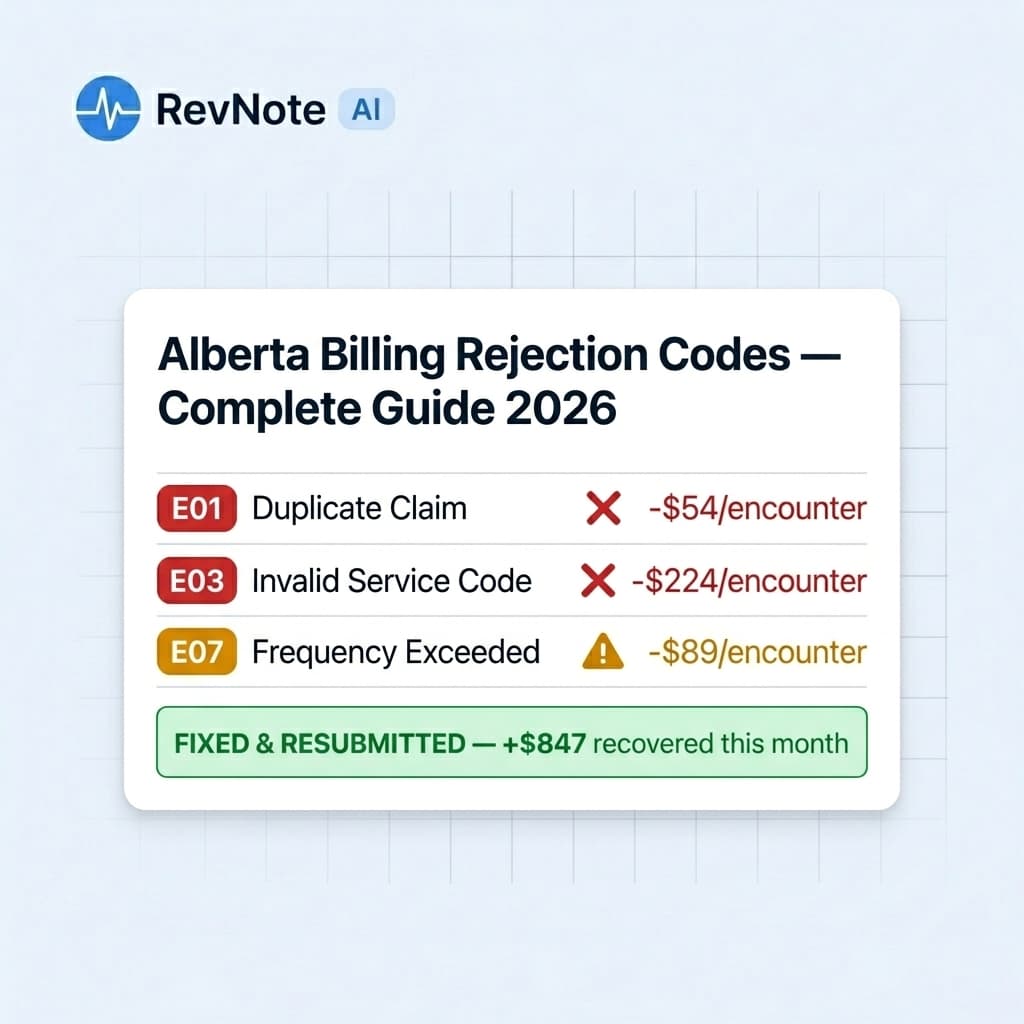
Why Alberta Claims Get Rejected
Alberta Health processes millions of physician claims per year through the AHCIP (Alberta Health Care Insurance Plan) system. Claims go through automated validation before any human review — and automated systems reject based on strict rules. The rejection notice arrives as an "explanatory code" on your remittance advice.
The three biggest sources of rejections for Alberta GPs in 2026 are:
- Outdated codes — the April 2026 SOMB update changed fee values and eligibility on multiple codes
- Bundling violations — billing two codes that SOMB considers included in each other
- Missing documentation — especially for modifiers like 03.05W, 03.63, and 03.05O that require specific clinical data points
The good news: unlike audit clawbacks (which can take months to recover from), most rejections can be identified and resubmitted within days. Here is every major rejection code you will encounter in Alberta, and exactly how to fix each one.
Every Alberta Rejection Code — Explained
Duplicate Claim
Frequency: Very CommonWhat This Means
Same service code, same patient, same date already submitted. Alberta Health's system flagged it as a potential duplicate. This does NOT necessarily mean the claim was wrong — it may be a legitimate second encounter.
How to Fix and Resubmit
Check your submission records first. If it's truly a duplicate, no action needed. If you saw the patient twice on the same day (AM and PM), document the separate encounter times (e.g., 10:15 AM and 3:40 PM) in your clinical note, then resubmit with a clear notation explaining the two distinct encounters.
Prevention: RevNote AI timestamps every billing suggestion and flags potential duplicate risk before submission.
Invalid Service Code
Frequency: CommonWhat This Means
The billing code submitted doesn't exist in the current SOMB schedule, has been discontinued, or the format was entered incorrectly (dashes vs. periods). This spikes every April when SOMB updates — codes from the previous year get rejected.
How to Fix and Resubmit
Verify the code against the current 2026 SOMB schedule. The April 2026 update changed fee values and eligibility on several codes. Common culprits: 03.04A (renamed), 03.08AB (split). Cross-reference with the official Alberta Health fee schedule PDF.
Prevention: RevNote AI is trained exclusively on SOMB 2026 — every suggestion uses the current, valid code set.
Service Not Eligible for Patient
Frequency: CommonWhat This Means
The service billed requires specific patient criteria — age, sex, diagnosis — that don't match the patient's Alberta Health registration. For example, 03.63B (Obesity Assessment) requires BMI ≥30 to be documented.
How to Fix and Resubmit
Review the eligibility criteria for the billed code in the SOMB. If the criteria ARE met, ensure your clinical documentation clearly states the relevant data points (e.g., 'BMI: 33.2 kg/m² measured today'). Resubmit with supplementary documentation if needed.
Prevention: RevNote AI validates patient eligibility criteria against SOMB rules before suggesting each code.
Exceeds Frequency Limit
Frequency: ModerateWhat This Means
The service has been billed more times than SOMB allows within a defined time window. The most common example: billing a Preventive Care visit (03.05B) more than once in a 12-month period for the same patient.
How to Fix and Resubmit
Check the SOMB frequency rules for the specific code (usually found in the 'Notes' or 'Limitations' column). If the additional service was truly medically necessary beyond the standard limit, submit an exception request with supporting clinical documentation explaining medical necessity.
Prevention: RevNote AI tracks frequency windows per patient per code to flag potential limit violations before they happen.
Time Conflict
Frequency: ModerateWhat This Means
Alberta Health's system detected overlapping service times — either two services billed at the same time for different patients, or a single encounter's time exceeds what's clinically reasonable for the billed complexity.
How to Fix and Resubmit
Review your encounter documentation for accurate times. Correct any timestamps that were auto-populated incorrectly by your EMR. If you use a dictation-based workflow, check that dictation timestamps match actual encounter times.
Prevention: Document precise start and end times for every encounter, especially for complex visits and procedures.
Missing or Invalid Referring Physician
Frequency: OccasionalWhat This Means
A service code that requires a valid referral was submitted without the referring physician's practitioner ID, or the ID entered doesn't match an active Alberta Health practitioner on record.
How to Fix and Resubmit
Obtain the correct Alberta practitioner ID for the referring physician (they must be licensed and active in Alberta Health's registry). Resubmit with the correct, complete referring practitioner number.
Prevention: Capture the referring physician ID at patient intake. Store frequently referred-to specialists in your EMR.
Documentation Insufficient
Frequency: Common (audit-triggered)What This Means
Alberta Health requested documentation to support a billed service, and what was provided didn't meet the SOMB criteria. This is the most expensive rejection because it often results in clawbacks of already-paid claims — sometimes months later.
How to Fix and Resubmit
Provide complete documentation that explicitly maps to SOMB eligibility criteria: (1) SOAP note with clinical findings, (2) specific numeric data where required (BMI value, PHQ-9 score, number of chronic conditions), (3) time of service, (4) patient consent where applicable.
Prevention: RevNote AI generates audit-proof SOAP documentation with phrase-level mapping to SOMB eligibility criteria for every billed code.
Not Billable — Included in Another Fee
Frequency: CommonWhat This Means
The service code submitted is considered part of another service already billed on the same day and cannot be billed separately. This is one of the most complex SOMB rules and varies significantly by code combination.
How to Fix and Resubmit
Review SOMB 'bundling' rules for the specific code combination. Some services are explicitly excluded when billed on the same day as others (e.g., certain procedures that include the office visit). If the services were clinically distinct and separate, document the clinical rationale clearly.
Prevention: RevNote AI checks bundling restrictions between modifiers and primary codes before making billing suggestions.
Case Study: Family Clinic in Red Deer, Alberta
Dr. M. (name anonymized) — solo GP, 25 patients/day, using Wolf EMR
- •47 E01 rejections — duplicate flag on same-day double encounters
- •23 E03 rejections — still using 2025 code format for 03.04A after April update
- •31 E15 flags during mid-year audit review
- •Total unrecovered revenue: $3,847 over 90 days
- •E01 rate: dropped 94% after documenting exact AM/PM encounter times
- •E03 rate: dropped to zero after switching to SOMB 2026 code set
- •E15: resolved by adding BMI, PHQ-9 scores to all relevant encounters
- •Recovered $3,210 via resubmission — plus ongoing prevention worth ~$1,050/month
The key insight: most rejections are systemic — fixing the root cause once prevents hundreds of future rejections.
Which Rejections to Fix First
Not all rejections are worth the same effort. Prioritize by dollar value × volume:
| Priority | Code | Reason | Effort |
|---|---|---|---|
| 🔴 Fix Today | E15 | Audit clawback risk — largest dollar exposure | Medium |
| 🔴 Fix Today | E03 | 100% recoverable once code is corrected | Low |
| 🟡 This Week | E01 | High volume, easy fix with time documentation | Low |
| 🟡 This Week | E05 | Eligibility data often already in chart | Low |
| 🟢 This Month | E07 | Requires frequency research per code | High |
| 🟢 This Month | E09 | EMR timestamp audit required | Medium |
Building a Rejection Prevention System
Fixing individual rejections is reactive. What separates high-billing physicians from average billers is a system that prevents rejections before they happen:
Pull your remittance advice every Monday. Batch-fix the week's rejections before they age. Rejections older than 60 days are significantly harder to support with documentation.
Every encounter note must include exact start time. This single habit eliminates E01 and E09 rejections almost entirely. Set it as a mandatory field in your EMR template.
Alberta Health updates SOMB every April 1. Block an hour in late March every year to review changed and discontinued codes. The 2026 update affected 03.04A, 03.08AB, and several telehealth codes.
For your top 10 billed codes, create EMR templates that automatically prompt for every required data point. For 03.63 (BMI): prompt for measured BMI. For 03.05O (PHQ-9): prompt for score and date administered.
Pick 15 random encounters per quarter and verify that the documentation would survive an E15 request. If not, fix the documentation template. Prevention costs 2 hours; clawbacks cost thousands.
Frequently Asked Questions
How long do I have to resubmit a rejected Alberta Health claim?
Alberta Health allows resubmission within 24 months of the date of service. However, best practice is to address rejections within 30-60 days while the clinical details are fresh and documentation is readily available.
What is the difference between a rejection and a denial in Alberta billing?
A rejection means the claim was not processed due to a technical error (invalid code, missing data, format issue). A denial means the claim was processed but payment was refused based on the clinical or eligibility review. Rejections are almost always fixable; denials require more formal appeal processes.
Can I bill an administrative fee for correcting rejected claims?
No — Alberta Health does not allow billing for claim correction or resubmission administrative work. This is exactly why preventing rejections upfront is so financially valuable.
Will resubmitting a claim after fixing it affect my audit risk?
Resubmitting corrected claims is standard practice and does not increase audit risk by itself. What matters is that your corrected submission is supported by proper clinical documentation. Poor documentation on resubmissions is a more significant audit trigger.
How do I find all my rejected claims in one place?
Alberta Health's Practitioner Claims System (in Netcare) provides a rejection report. Most EMRs (Wolf, Accuro, OSCAR) also aggregate rejection reports in their billing module. The key is reviewing these reports weekly, not monthly — stale rejections are harder to document and fix.
Related Articles
Related Billing Guides
Stop Losing $1,050/Month to Rejected Claims
RevNote AI validates every billing suggestion against SOMB 2026 rules before submission. E01, E03, E05, E15 — caught before they become rejections. Audit-ready documentation. 10 encounters free.
No credit card. No EMR integration. Works in under 60 seconds.